

20mm vs 30mm Kitchen Worktops: Which Thickness Is Right for London Kitchens?
May 10, 2026
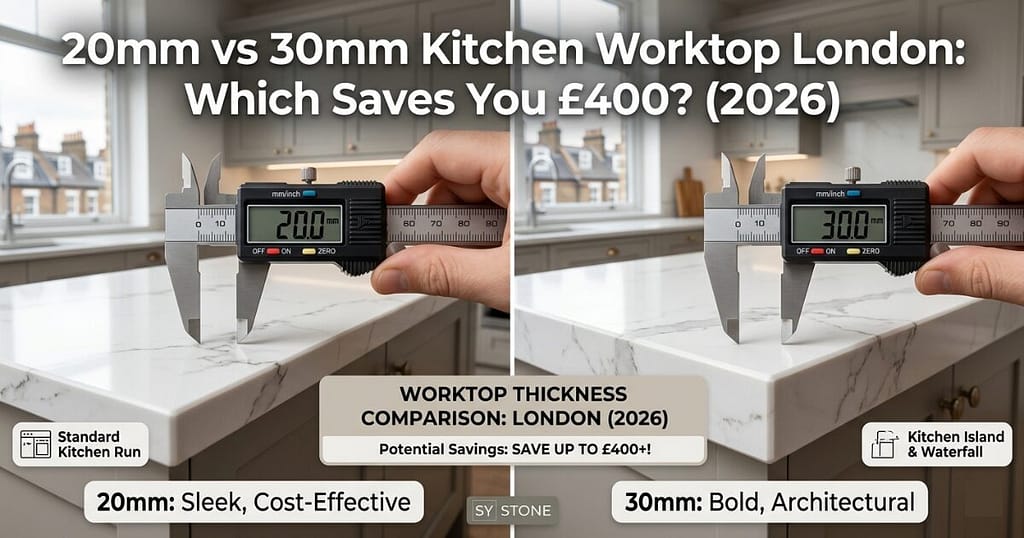
For most domestic London kitchens, 20mm stone worktops are the practical and cost-effective choice. 30mm is recommended for kitchen islands, waterfall edges, heavily used commercial surfaces, and design statements where visual weight matters. The right decision depends on your material, usage, cabinetry, and budget — this guide walks through every factor.
What Do 20mm and 30mm Actually Mean?
When stone worktop fabricators refer to 20mm and 30mm, they are talking about the thickness of the slab from the top surface down to the underside — measured at the edge. This is not a marketing term. It is a genuine structural and aesthetic difference that affects cost, installation complexity, cabinet load, and the visual presence of your worktop in the kitchen.
At SY STONE, we fabricate and install both thicknesses across London every week — in Harrow, Kingston, Watford, and Edgware, as well as central London boroughs from Islington to Wandsworth. In our experience, the thickness question is one of the most common decisions clients face, and one of the most misunderstood.
The Core Difference at a Glance
| Feature | 20mm Worktop | 30mm Worktop |
|---|---|---|
| Standard use | Domestic kitchen runs | Islands, statement pieces |
| Visual weight | Sleek, minimal | Bold, architectural |
| Cost in London (installed) | Lower — approx. 20–30% less than 30mm | Higher |
| Cabinet load | Standard — suits all cabinet types | Heavier — check cabinet ratings first |
| Edge profile options | Most profiles available | Full range, including deep mitred waterfall |
| Best materials | Quartz, granite, marble, porcelain | Quartz, granite, ultra-compact (Dekton) |
| Unsupported overhang | Up to 200mm | Up to 300mm (material dependent) |
| Ideal for | Wall runs, flats, rental properties | Islands, waterfalls, commercial spaces |
20mm Kitchen Worktops in London: Who They Are Right For
The 20mm slab is the industry standard for residential kitchen installations across the UK and remains the most commonly installed thickness in London domestic kitchens. It is not a compromise — it is a precision-engineered specification that suits the vast majority of London homes.
20mm suits you if:
- Your kitchen has standard runs along a wall with no island
- You are working with typical residential cabinets (standard 600mm depth)
- You want the cleanest, most contemporary edge appearance
- Budget is a priority without sacrificing material quality
- Your material is quartz, granite, or marble and receives moderate to heavy daily use
- You are a landlord, developer, or managing a rental property fit-out
At SY STONE, the majority of our London residential installations use 20mm slabs. In compact London kitchens — the kind you find in Victorian terraces across Islington and Hackney, or purpose-built flats in Harrow and Wembley — 20mm is the specification that works structurally, aesthetically, and economically.
💷 Typical 20mm Cost in London (2026)
Expect to pay approximately £250–£700 per linear metre installed, depending on material. Quartz sits at the lower to mid range; marble at the upper end. Figures include templating, CNC fabrication, delivery, and professional installation.
30mm Kitchen Worktops in London: When the Upgrade Is Worth It
The 30mm slab is a visual and structural upgrade that makes sense in specific scenarios. The additional 10mm of material adds cost, weight, and fabrication time — but in the right application, it transforms the look and longevity of a kitchen.
30mm suits you if:
- You are installing a kitchen island and want a bold, substantial top
- You want a waterfall edge — where the worktop cascades vertically to the floor
- Your kitchen has a Shaker or traditional design where visual weight reads as premium
- You are fitting a commercial kitchen or hospitality space
- You want an extended breakfast bar overhang without corbel support
- The slab needs to be self-supporting on open shelving or furniture-style cabinetry
30mm is also common in high-end residential new builds and full renovation projects where clients are investing significantly and want material that reads as architectural, not appliance-grade.
💷 Typical 30mm Cost in London (2026)
Expect to pay approximately £350–£900 per linear metre installed. The cost premium over 20mm comes from additional raw material, longer CNC cutting time, and the greater care required during installation and transport.
Material-by-Material: Does Thickness Change by Stone Type?
Yes — and this is where the decision gets more nuanced. Different stone materials behave differently at different thicknesses.
Quartz Worktops: 20mm or 30mm?
Engineered quartz is the most flexible material for thickness decisions. It is manufactured to precise tolerances, meaning 20mm quartz is genuinely 20mm — consistent across the entire slab. This makes it suitable for most kitchen configurations. Popular finishes available in both thicknesses include Calacatta White, Taj Mahal, Carrara, and anthracite tones.
➤ SY STONE recommendation: 20mm quartz for standard London kitchen runs; 30mm for islands, waterfall details, or where a premium finish is the priority.
Granite Worktops: 20mm or 30mm?
Granite is a natural stone and inherently heavier than engineered quartz. A 30mm granite slab across a full kitchen run places significant load on cabinets — particularly the flat-pack or modular units common in London builds. We always check cabinet ratings before specifying 30mm granite across long runs.
➤ SY STONE recommendation: 20mm granite for most domestic applications; 30mm reserved for islands and short statement sections where cabinet strength has been confirmed.
Marble Worktops: 20mm or 30mm?
Marble is a softer stone and benefits from additional thickness where heavy use or significant overhangs are expected. However, 30mm marble over a full kitchen run is expensive and heavy.
➤ SY STONE recommendation: 20mm marble for most London installations, with 30mm specified for marble islands or heritage kitchen designs where the visual mass of the stone is part of the aesthetic.
The Kitchen Island Question: Why 30mm Dominates This Application
The kitchen island is the single most common reason London clients upgrade from 20mm to 30mm. Here is why:
Visual proportion: An island is a freestanding centrepiece. A 20mm top on a large island can look thin relative to the mass of the base unit below. 30mm reads as deliberate, premium, and balanced.
Overhang seating: Islands used as breakfast bars typically have a 300mm overhang for bar stools. At this span, 30mm stone is structurally more appropriate — reducing the need for corbel support that can interrupt the clean underside profile.
Waterfall edges: If you want the worktop to drop vertically to the floor on one or both ends of the island, the mitre joint must be cut through the full thickness of the slab. 30mm waterfall joints are visually superior — the mitre appears as a confident, deliberate line rather than a thin seam.
💡 SY STONE Installer Tip
A popular London approach is 20mm along wall runs + 30mm for the island only. This lets you invest the 30mm premium exactly where it creates the most visual impact, while keeping the overall project cost efficient. The difference in thickness is rarely visible from the same sightline.
How Cabinet Specification Affects Thickness Choice
This detail is overlooked by many clients — and some fitters. Your existing cabinet specification matters.
Standard flat-pack kitchens from IKEA, Howdens, Wren, and similar suppliers are tested and rated for worktop loads. Most handle 20mm stone without issue. Some manufacturers explicitly advise against 30mm stone across unsupported spans above 800mm without intermediate support.
If you are fitting 30mm stone onto flat-pack cabinets:
- Check the cabinet manufacturer’s stated load rating
- Ensure cabinets are fully squared, levelled, and wall-secured before templating
- Discuss intermediate corbel support with your fabricator for spans above 1200mm
At SY STONE, our pre-installation site survey includes a full review of your cabinetry specification before we confirm any thickness recommendation. This is part of our standard templating visit — not a chargeable add-on.
Edge Profiles and Thickness: What Pairs Best
Your choice of edge profile is directly influenced by worktop thickness. Thicker stone opens up more dramatic options.
20mm Edge Profiles
- Pencil round
- Flat polish / pencil bevel
- Ogee (traditional)
- Half-bullnose
- Chamfer / angled bevel
30mm — Additional Options
- Full bullnose
- Waterfall mitre join
- Deep ogee with undercut
- Stacked / laminated edge
- Triple pencil detail
For a full breakdown of edge profiles for London kitchens, read our detailed guide: How to choose the right edge profile during kitchen worktops installation.
Weight and Access: A Practical London Reality
London homes present access constraints that mainland or rural installations rarely encounter. Narrow hallways in Victorian terraces, steep stairwells in mansion flats, tight service lifts in new builds — all of these affect how stone is moved and installed.
~95 kg
20mm quartz slab
3000mm × 600mm typical run
~140 kg
30mm quartz slab
Same dimensions — 47% heavier
In practical terms, a 30mm slab often requires an additional installer, specialist lifting equipment, or pre-cutting the slab off-site into manageable sections (which then requires a perfectly aligned join on-site). None of this is impossible — but it is a cost and logistics consideration specific to dense London housing stock.
SY STONE plans access logistics as part of every pre-installation survey. For listed buildings and mansion flats, we have completed complex lifts and deliveries with zero surface damage to properties.
Full Cost Summary: What to Budget in London 2026
These are real-world installed costs based on our London projects:
| Specification | Installed Cost Per Linear Metre |
|---|---|
| 20mm quartz (standard finish) | £280 – £520 |
| 20mm granite | £260 – £600 |
| 20mm marble | £380 – £750 |
| 30mm quartz (standard finish) | £370 – £680 |
| 30mm granite | £350 – £750 |
| 30mm marble | £480 – £900 |
| 30mm waterfall island (per waterfall face) | Add £400 – £800 per drop |
All figures include templating, CNC fabrication, installation, and finishing. Sink and hob cutouts, drainage grooves, and upstands quoted separately. Prices vary by London postcode.
For a full breakdown, read our guide: How much does kitchen worktop installation in London cost in 2026?
SY STONE’s Decision Framework: Choose Your Thickness in 60 Seconds
✓ Choose 20mm if…
- Standard wall runs, no island
- Flat-pack or modular cabinets
- Budget is a key factor
- Contemporary, sleek aesthetic
- Rental or investment property
- Compact London flat or terrace
- Quartz, granite, or marble material
✓ Choose 30mm if…
- Kitchen island, especially with seating
- Waterfall edge detail planned
- Full bespoke or furniture-style kitchen
- Commercial or hospitality project
- Traditional or heritage property
- Material budget allows the premium
- Extended overhang above 200mm
Why London Homeowners Choose SY STONE for Worktop Installation
At SY STONE, we do not outsource fabrication. Every slab — whether 20mm or 30mm — is cut, profiled, and finished in our own London workshop using CNC machinery to tolerances of ±0.5mm. Our installation teams are experienced in London’s specific access challenges, property types, and cabinetry configurations.
We work across all London boroughs and surrounding areas including Harrow, Kingston, Watford, Edgware, and across Greater London.
- ✔ Free onsite templating and written quotation
- ✔ In-house CNC fabrication — no outsourcing
- ✔ Invisible seams engineered to ±0.5mm tolerance
- ✔ Quartz, granite, and marble specialists
- ✔ Workmanship warranty on every installation
- ✔ Residential and commercial projects across London
Ready to choose your worktop thickness?
Our London specialists visit your property free of charge, assess your cabinetry and space, and give you a clear written recommendation — no obligation.
Or call us: 07401644531
Frequently Asked Questions
Written by the SY STONE Installation Team
SY STONE are specialist kitchen worktop fabricators and installers based in London NW2, serving residential and commercial clients across Greater London. We fabricate all worktops in-house using CNC machinery and install with a full workmanship warranty. For a free onsite template and quote, call 07401644531 or visit systone.co.uk.