

Quartz vs Porcelain Kitchen Worktops London: Honest Material Comparison for 2026 Buyers
May 7, 2026
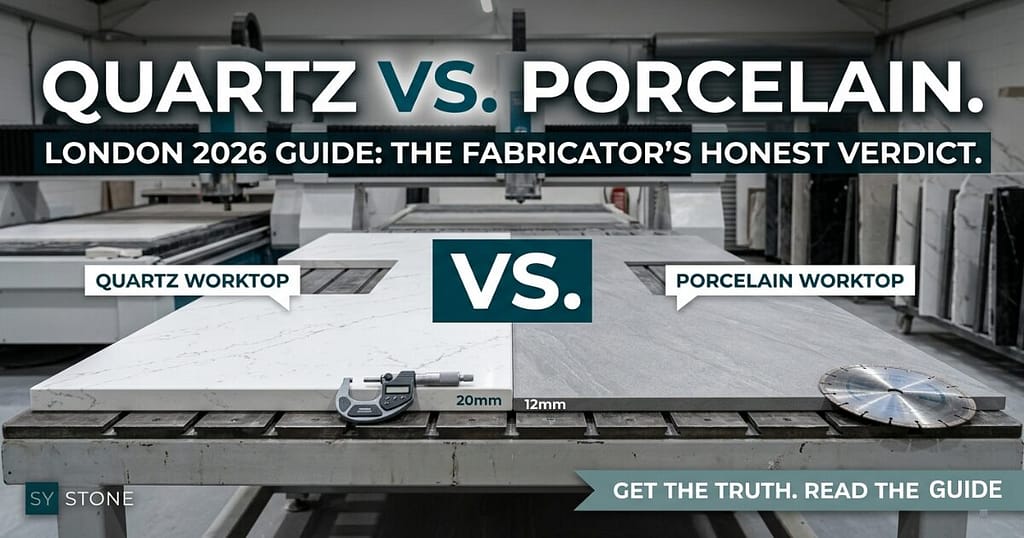
Quartz is the better choice for most London kitchens. It offers a wider colour selection, simpler edge profiling, and more competitive pricing from London fabricators. Porcelain is the better choice for outdoor kitchen worktops and UV-exposed spaces. Both are non-porous, stain resistant, and heat tolerant — but they differ significantly in fabrication difficulty, edge options, and long-term repairability.
If you are renovating a kitchen in London right now, you have almost certainly been told to consider quartz. What you may not have been told is that porcelain worktops are becoming increasingly popular — and that in certain situations, porcelain genuinely outperforms quartz.
At SY STONE, our team fabricates and installs both materials across Greater London — from Victorian terraces in Hackney to new-build apartments in Stratford. In this guide, we give you an honest, no-marketing comparison of quartz and porcelain, so you can make the right decision for your kitchen, your budget, and your lifestyle.
- At a Glance: Key Differences Comparison Table
- What Is a Quartz Worktop?
- What Is a Porcelain Worktop?
- Cost Comparison — London 2026 Pricing
- Heat Resistance
- Scratch & Stain Resistance
- Aesthetics & Design Options
- London Flats & Rental Properties
- Outdoor Kitchens in London
- Fabrication & Installation
- SY STONE’s Honest Verdict
- Frequently Asked Questions
At a Glance: Quartz vs Porcelain Worktops — Key Differences
The table below summarises the most important differences between quartz and porcelain kitchen worktops for London homes in 2026. Detailed explanations of each property follow in the sections below.
| Property | Quartz Worktop | Porcelain Worktop |
|---|---|---|
| Material type | Engineered stone (93% quartz + resin) | Fired ceramic (clay, minerals, pigments) |
| London installed cost | £300 – £800 per linear m² | £400 – £900 per linear m² |
| Thickness available | 12mm, 20mm, 30mm | 6mm, 12mm, 20mm |
| Heat resistance | Up to ~150°C (avoid direct pan contact) | Up to 300°C+ (high thermal tolerance) |
| UV resistance | ❌ Fades in direct sunlight | ✅ 100% UV stable |
| Scratch resistance | Very good | Excellent |
| Stain resistance | ✅ Excellent (non-porous) | ✅ Excellent (non-porous) |
| Sealing required | ✅ No | ✅ No |
| Edge profile options | ✅ Extensive (pencil, ogee, waterfall…) | ⚠️ Limited (mainly eased/straight) |
| Repairability | ✅ Chips can often be polished or filled | ❌ Chips very difficult to repair |
| Best for | Indoor kitchens, islands, rental properties | Outdoor kitchens, UV-facing surfaces |
| SY STONE verdict | ✅ Recommended for most London homes | ✅ Recommended for outdoor / UV kitchens |
Table data based on SY STONE fabrication experience and London market pricing, May 2026.
What Is a Quartz Worktop?
Engineered quartz worktops are made from approximately 93% crushed natural quartz bound together with polymer resins and pigments. The material is pressed under vacuum and cured, producing a consistent, non-porous slab.
Because the manufacturing process is controlled, every quartz slab delivers the same density, the same surface hardness, and the same colour throughout — which matters enormously for London kitchen renovations where you may need multiple slabs to cover an island, a run, and a peninsula without visible variation.
- Requires no sealing, staining, or specialist maintenance — ever
- Colour range spans concrete-look greys to Calacatta and Carrara marble-effect finishes
- Widely available across London, keeping lead times short (typically 3–4 working days after templating)
- Edge profiles are easy to machine — waterfall, ogee, or bullnose without premium upcharges
- Available in 12mm, 20mm, and 30mm — suitable for everything from a compact flat kitchen to a full island
SY STONE installs quartz worktops across all London boroughs, with full in-house CNC fabrication from our Dollis Hill workshop. We source quartz in Calacatta, Carrara, Taj Mahal, and contemporary concrete finishes.
What Is a Porcelain Worktop?
Porcelain worktops are manufactured by firing clay, feldspar, silica, and mineral pigments at temperatures above 1,200°C. The resulting material is dense, hard, and genuinely non-porous from the fired surface all the way through.
Modern large-format porcelain slabs — sometimes marketed as sintered stone or ultracompact surfaces — have made porcelain a viable worktop material in the last five to ten years. Brands such as Dekton by Cosentino, Neolith, and high-end Italian producers have pushed this category into mainstream London kitchen design.
- 100% UV stable — colours and finishes will not fade in direct sunlight
- Heat resistance significantly higher than quartz — withstands 300°C+
- Available in very large slab formats, meaning fewer joins on a long run or island
- Fired through to the core — not a surface coating over a weaker substrate
Porcelain has one significant fabrication challenge that is rarely mentioned in marketing materials: it is brittle at cut-out edges. Sink cut-outs, hob cut-outs, and tap holes in porcelain require diamond-tipped CNC tooling and experienced fabricators. Done incorrectly, the edges can micro-crack — and unlike a quartz chip which can often be filled and polished invisibly, a cracked porcelain worktop is extremely difficult to repair. This is not a material weakness; it is a fabricator-selection issue. Always verify your fabricator has in-house CNC porcelain experience before signing.
At SY STONE, we fabricate porcelain using diamond-tipped CNC tooling in our London workshop. We will always be honest about whether porcelain is the right material for your specific project before recommending it.
Cost Comparison — Quartz vs Porcelain Worktops in London (2026)
Cost is the most common question we receive at SY STONE. Here is an honest breakdown based on our current London pricing for a standard kitchen with 4–6 linear metres of worktop.
SY STONE transparency note: We quote both materials honestly at the site visit. If quartz fulfils your brief, we will not push porcelain for margin. If porcelain is genuinely the better material for your project — for example, an outdoor kitchen in a south-facing London garden — we will say so clearly.
For a full breakdown of all worktop material costs in London, read our London kitchen worktop installation cost guide for 2026.
Heat Resistance — Which Handles Hot Pans Better?
This is the question most London homeowners get wrong, and it is one of the most important differences between these two materials.
Quartz heat tolerance
Engineered quartz can typically withstand temperatures up to approximately 150°C before the resin binder begins to discolour or blister. A hot mug or a warm pan placed briefly on the surface will not cause damage. A cast-iron skillet straight from a high-heat hob or oven — which can reach 250°C+ — can and does cause permanent discolouration to quartz if placed directly on it.
Porcelain heat tolerance
Porcelain is fired at temperatures above 1,200°C during manufacture. In real-world use, a cast-iron pan directly off a high-heat hob will not damage a porcelain surface. If you cook heavily — whole-pot braising, high-heat wok cooking, constant pan transfers from oven to surface — porcelain’s thermal stability is a genuine practical advantage.
For a detailed heat test breakdown across all worktop materials, read our heat resistance guide: which worktops can actually handle hot pans.
Scratch and Stain Resistance — Day-to-Day London Kitchen Performance
Scratch resistance
Both quartz and porcelain score very highly for scratch resistance in day-to-day use. Neither material should be used as a direct cutting surface — a chopping board is always recommended regardless of material. Porcelain has a slightly higher Mohs hardness rating than quartz, meaning it is marginally more scratch resistant in laboratory conditions. In real-world London kitchen use, both materials perform identically.
Stain resistance
Both quartz and porcelain are non-porous. Neither requires sealing. Red wine, coffee, olive oil, and bleach-based cleaning products will not permanently stain either surface if cleaned promptly with warm water.
Aesthetics — Design Options for London Kitchens in 2026
If your kitchen renovation is design-led, this section matters significantly. The two materials are not equal on aesthetics — and the difference is most visible in edge profiling.
- Calacatta Gold, Carrara Bianco, Taj Mahal marble effects
- Contemporary concrete-look and solid-colour options
- Consistent colour across full slab run
- Extensive edge profiles: pencil, ogee, radius, waterfall, mitre-join
- Ideal for Shaker, traditional, and cream kitchens
- Beautiful marble-effect and terrazzo finishes in large slab formats
- Fewer joins on long runs due to larger slab sizes
- Edge profiles mainly eased or straight (complex profiles risk chipping)
- Best suited to contemporary, handleless, open-plan kitchens
- Not recommended for Shaker or ornate traditional kitchens
For cream kitchens, Shaker kitchens, or period-style properties in London, quartz is the more versatile aesthetic choice. If you have a cream kitchen, read our complete guide: What worktop goes with a cream kitchen? The ultimate London guide.
Which Is Better for London Flats and Rental Properties?
London flats and rental properties have specific demands: limited access, tight timelines, durability for high tenant turnover, and materials that require minimal ongoing maintenance.
Quartz is the clear recommendation for London flats. It requires no ongoing maintenance, is available in thinner 12mm formats that reduce weight load (relevant in Victorian conversion flats where floor loading is a consideration), and is widely available across London fabricators. Access constraints typical of mansion block and conversion-flat installations — narrow staircases, compact lifts, tight kitchen footprints — also make handling large-format porcelain slabs significantly more logistically challenging.
Mid-range quartz is the material we recommend to every landlord client at SY STONE. It is non-porous, it does not show wear the way laminate does after two or three tenancy cycles, it does not require a specialist maintenance call when a tenant marks it, and it maintains its visual quality and resale appeal over a 10+ year property investment horizon.
Which Is Better for Outdoor Kitchens in London?
This is where the comparison flips decisively in porcelain’s favour — and we say this even though we install significantly more quartz than porcelain overall.
We do not install quartz in outdoor kitchen applications. We tell every client this honestly at the site visit, before they spend a pound.
Quartz contains resin binders that are not UV stable. In a south-facing London garden where the worktop receives consistent direct sunlight, quartz will fade and discolour — often within two to four years of installation. For a covered outdoor kitchen, a garden bar, or a BBQ preparation surface, porcelain is not just the better choice. It is the correct material, and quartz is the wrong one.
Porcelain is 100% UV stable and frost resistant — it handles the freeze-thaw cycle that London winters reliably produce. For any outdoor application, porcelain is the material you need. SY STONE installs outdoor porcelain worktops across London. Request a free quote for your outdoor kitchen here.
Fabrication and Installation — What Is Different in London?
At SY STONE, we fabricate both quartz and porcelain in our own London workshop using CNC machinery. We do not outsource fabrication to a third party. This matters for both materials, but the difference is most critical for porcelain.
Quartz fabrication in our London workshop
CNC cutting and edge profiling of quartz is well established in our workshop. Our process allows us to achieve invisible seams, precise cut-outs for sinks and hobs, and edge profiles to exact specification. Turnaround from template to installation is typically 3–4 working days for quartz projects across London.
Porcelain fabrication — why experience matters
Porcelain requires diamond-tipped cutting discs and experienced CNC operators who understand the material’s brittleness under lateral stress. Cut-out edges must be finished precisely to prevent micro-cracking. A fabricator without genuine porcelain experience — or one who uses standard quartz tooling on a porcelain slab — will produce sink cut-outs at real risk of edge failure within months of installation.
Do you have in-house CNC capability? If the answer is no, your slabs are being sent to a third-party workshop. Quality control, tolerances, and accountability all weaken when fabrication is outsourced. SY STONE: Yes — our Dollis Hill workshop.
Can you show me completed porcelain installations with photos? Any experienced porcelain fabricator has a portfolio. If photos are unavailable or vague, you are likely their first or second porcelain project. SY STONE: Yes — request project photos when you enquire.
SY STONE’s Honest Verdict — Which Should You Choose?
After fabricating and installing both materials across hundreds of London projects, here is our genuine recommendation — not a marketing recommendation, a fabricator’s recommendation.
In the majority of London kitchens in 2026, quartz is the right material. Porcelain is the right material in well-defined circumstances — and those circumstances are less common than porcelain manufacturers would like you to believe. An honest fabricator will tell you the same.
If you are unsure which material is right for your specific project, contact SY STONE. We will visit your London property, assess your kitchen — including natural light direction, usage patterns, and access — and give you a genuine recommendation before you commit to either material.
Get a Free Onsite Quote from SY STONE
Free onsite templating across all London boroughs · In-house CNC fabrication · Invisible seams · Workmanship warranty
Serving Harrow, Kingston, Watford, Edgware, NW2 and all Greater London areas
Frequently Asked Questions — Quartz vs Porcelain Worktops London
This guide was written based on direct fabrication and installation experience at SY STONE — a London-based stone worktop company operating from our Dollis Hill, NW2 workshop. We have installed quartz and porcelain worktops across all London boroughs, for residential homeowners, buy-to-let landlords, and commercial clients. Every recommendation in this guide reflects real material performance from real London projects. We do not accept supplier sponsorship or paid placement.